Baby fever: when to call the doctor, by age
What counts as a fever in babies, how to take their temperature, when to call the doctor by age, emergency red flags, comfort care and medicine safety.
Educational content only, not medical advice. Always talk to your doctor or health visitor about your child.
In this article
- What temperature is a fever in a baby?
- How do I take my baby's temperature?
- When should I call the doctor about my baby's fever?
- When is a fever an emergency?
- How can I make my baby comfortable with a fever?
- Can I give my baby medicine for a fever?
- Could teething cause a fever?
- Should I keep a record of my baby's temperature?
A fever in a baby or child is a temperature of 38°C (100.4°F) or higher. Any baby under 3 months with a temperature of 38°C (100.4°F) or more needs medical help right away, even if they seem otherwise well. The NHS also says to get medical advice for a baby aged 3 to 6 months with a temperature of 39°C (102.2°F) or higher. At any age, call your emergency number if your child has a rash that does not fade under a glass, is floppy or hard to wake, is struggling to breathe or has a seizure.
This guide is educational, not medical advice. If you are worried about your child, trust your instincts and contact your doctor, health visitor or paediatrician, or call NHS 111 in the UK. In an emergency, call your emergency number (999 in the UK, 911 in the US).
What temperature is a fever in a baby?
Both the NHS and the AAP use 38°C (100.4°F) as the line for a fever. The NHS says a normal temperature is about 36.4°C (97.5°F), though it varies slightly from child to child.
A fever is the body's natural response to infection, and most fevers in children are caused by common viral illnesses. The number on the thermometer matters most in young babies. In older babies and children, how your child is acting usually tells you more than the exact reading.
How do I take my baby's temperature?
This is one area where US and UK advice differs.
| Method | AAP (US) | NHS (UK) |
|---|---|---|
| Rectal (digital) | Most accurate, best choice under 3 months | Not mentioned in NHS guidance |
| Armpit (digital) | Least accurate, fine for screening at any age | Recommended, always use for under 5s |
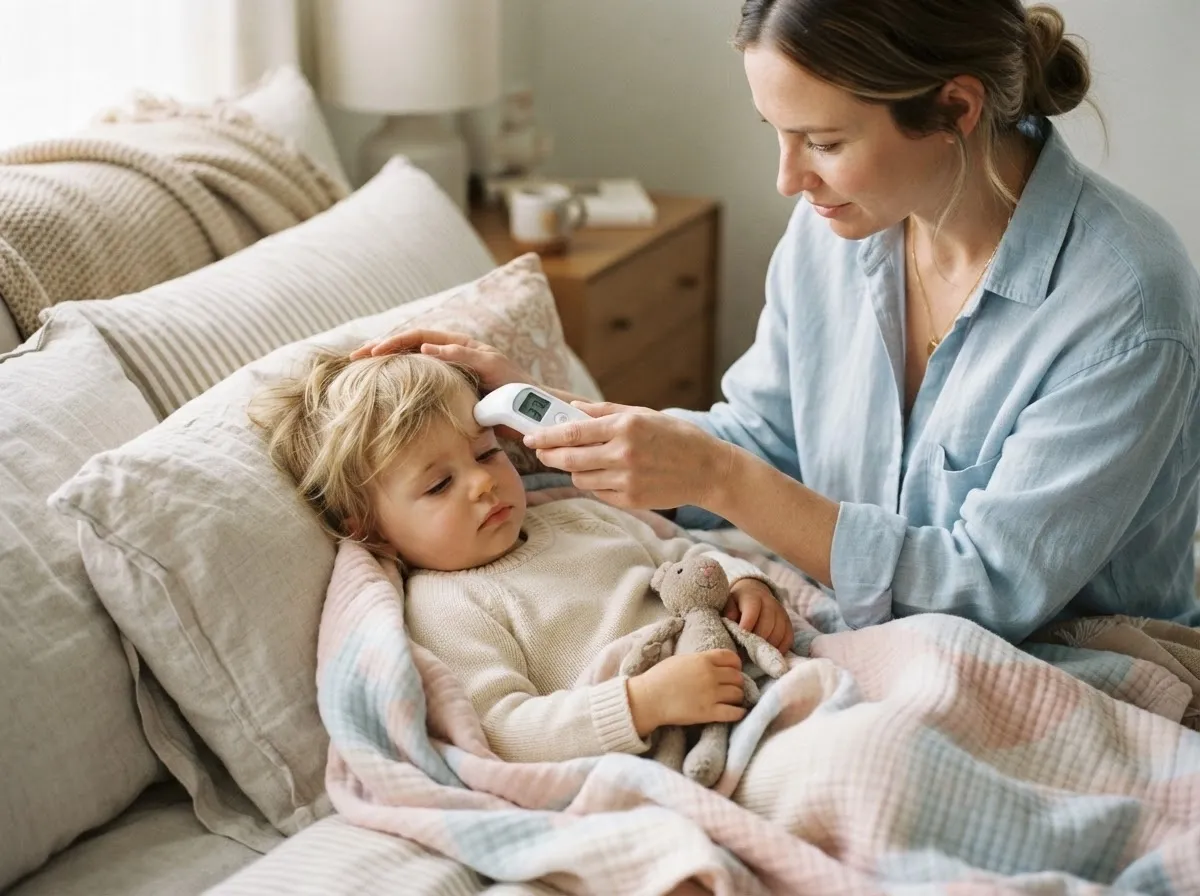
| Forehead (temporal artery) | Can be used at any age | Strip thermometers not accurate |
| Ear | From 6 months only | Can mislead if not placed correctly |
| Mouth (oral) | From age 4 | Armpit advised instead for under 5s |
Both agree: use a digital thermometer, never a mercury glass thermometer, and do not rely on feeling your baby's forehead or on fever strips.
Digital baby thermometer
A thermometer you trust matters more than any app. Ask your pharmacist which type suits your baby's age.
Tips for an accurate reading:
- Wait 15 minutes after coming in from the cold before using an ear or forehead thermometer, as the AAP advises.
- For an armpit reading, hold your baby's arm gently against their side until the thermometer beeps.
- For a rectal reading, the AAP says insert about 1.25 cm (half an inch) for babies under 6 months.
- Write down the reading, the time and the method you used.
When should I call the doctor about my baby's fever?
Age is the most important factor.
Under 3 months: 38°C (100.4°F) or higher. Get medical help right away, even if your baby seems well. Call your doctor or NHS 111. The AAP says fever in the first 12 weeks may signal a serious infection and needs immediate medical attention. Do not give fever medicine before speaking to a doctor.
3 to 6 months: The NHS says call 111 or your GP for 39°C (102.2°F) or higher. The AAP's threshold is lower: it says to call your paediatrician for 38.3°C (101°F) or higher. If you are in doubt, call.
Over 6 months: The AAP says call for 39.4°C (103°F) or higher. At any age, the NHS says to call 111 or your GP if:
- The fever has lasted 5 days or more
- Your child has other signs of illness, such as a rash
- They are not eating, or not acting like themselves, and you are worried
- They show signs of dehydration
Signs of dehydration (NHS): nappies (diapers) that are not very wet, sunken eyes, and no tears when crying. Our guide to newborn poop and wet nappies explains what is normal.
When is a fever an emergency?
Call your emergency number (999 in the UK, 911 in the US) if your child:
- Has a rash that does not fade when you press a glass against it
- Is floppy, drowsy and hard to wake, or barely responds to you
- Has difficulty breathing, or is breathing fast
- Has a fit (seizure) for the first time, or a fit that does not stop
- Has a stiff neck or is bothered by light
- Has blue, grey, pale or blotchy skin, lips or tongue
- Has unusually cold hands and feet with a fever
- Is extremely agitated or confused, or crying in a way that does not sound like them
Febrile seizures (fits caused by a fever) can happen between 6 months and 5 years. They are frightening, and most are not harmful, but a first one always needs emergency help. Lay your child on their side on a safe surface, do not put anything in their mouth, and call for help.
How can I make my baby comfortable with a fever?
The NHS advice for caring for a child with a fever at home:
- Give plenty of fluids. Keep breastfeeding or offering formula. Older children can have water.
- Offer food if they want it, but do not worry if they eat less for a day or two.
- Dress them normally. Do not wrap them up in lots of layers or blankets.
- Do not undress them or sponge them down to cool them. The NHS advises against this.
- Check on them regularly, including through the night.
- Keep them at home and away from nursery or school while they have a fever.
Cool mist humidifier
Moist air can make dry winter nights more comfortable. Clean it often.
Some parents use a cool mist humidifier to keep the air in a baby's room comfortable during colds. Clean it as the manufacturer recommends. It is not a treatment for fever.
Can I give my baby medicine for a fever?
You do not have to bring a fever down if your child is comfortable. Medicine is for comfort, not to make the number go away. If you do give medicine:
- Never give aspirin to children. The NHS says no aspirin for anyone under 16. The AAP strongly advises against aspirin during viral illnesses such as flu or chickenpox because of the risk of Reye syndrome.
- Paracetamol (acetaminophen in the US) and ibuprofen can help a child who is uncomfortable. Use only a product made for children, follow the label for your child's age and weight, and use the syringe or spoon that comes with it, never a kitchen spoon.
- Age rules differ by country. The NHS says do not give paracetamol to babies under 2 months, and do not give ibuprofen to babies under 3 months or under 5 kg (11 lb). The AAP says do not use ibuprofen under 6 months unless your doctor tells you to, and to check with a doctor before giving acetaminophen to a child under 2.
- Do not give ibuprofen if your child is dehydrated or has chickenpox, and the NHS says not to give it to children with asthma unless a doctor says so.
- Do not alternate or combine paracetamol and ibuprofen unless a health professional tells you to.
If you are unsure about the right medicine or dose, ask a pharmacist or your doctor.
Baby first aid kit
Plasters, saline, a medicine syringe and the basics in one pouch.
A first aid kit with a children's thermometer, dosing syringes and your child's usual medicines in one place makes nights like these easier.
Could teething cause a fever?
Teething does not usually cause a true fever. The AAP says a fever, or a baby who seems especially miserable, is probably not due to teething and is worth checking with your doctor. Our teething guide covers what teething does and does not cause.
Should I keep a record of my baby's temperature?
Noting each temperature reading, the time, any medicine given, and how much your child is drinking and how many wet nappies they have helps your doctor or NHS 111 understand what is happening.
Baby Growth Tracker Pro logs feeds, sleep, nappies, growth and milestones in one place, and works offline. For more care guides, visit our baby care hub, or read about why babies cry when they are unwell.
Frequently asked questions
What temperature is too high for a baby?
For any baby under 3 months, 38°C (100.4°F) or higher needs medical help right away. For 3 to 6 months, the NHS says to call for 39°C (102.2°F) or higher, while the AAP says 38.3°C (101°F). For older babies, how they are acting matters more than the exact number.
Which thermometer is best for a baby?
The AAP says a digital rectal reading is most accurate, especially under 3 months. The NHS recommends a digital thermometer under the armpit for children under 5. Never use a mercury thermometer, and avoid ear thermometers under 6 months.
Can I give paracetamol and ibuprofen together?
The NHS says not to alternate them unless a health professional advises it, and the AAP advises against giving both together. Use one, and follow the label for your child's age and weight.
How long can a fever last in a child?
Most fevers from common viral illnesses pass within a few days. The NHS says to contact your GP or NHS 111 if a fever lasts 5 days or more, or sooner if you are worried.
Is a fever after vaccines normal?
A mild fever can happen after some vaccines. Follow the advice your nurse or doctor gave you at the appointment, and get medical help if your baby seems unwell or you are worried.
Some links on this page go to Amazon. As an Amazon Associate we earn from qualifying purchases. It never changes the price you pay.