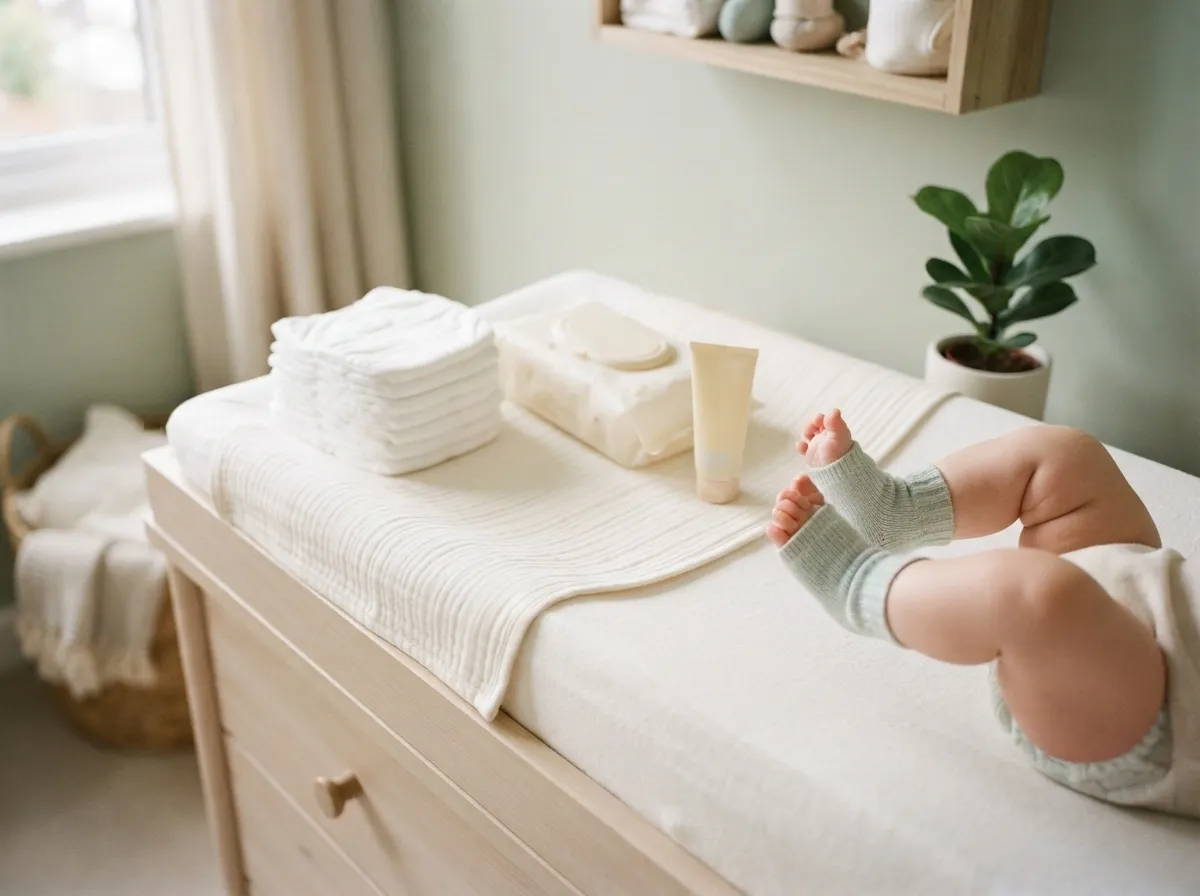
Your newborn's first weeks: a practical survival guide
What to expect in your newborn's first weeks: weight loss, feeding, cord care, bathing, jaundice, skin and nails, safe sleep, going out and baby blues.

Educational content only, not medical advice. Always talk to your doctor or health visitor about your child.
In this article
- How much weight do newborns lose after birth?
- How often should a newborn feed?
- How do I look after the umbilical cord stump?
- How often should I bath a newborn?
- Is jaundice normal in newborns?
- What is normal for newborn skin and nails?
- How do I keep my newborn safe while sleeping?
- When can I take my newborn out?
- What about me? Baby blues and postnatal depression
- How can I keep track of the first weeks?
In the first weeks, expect your baby to feed at least 8 to 12 times every 24 hours, lose a little weight in the first few days and be back to birth weight by about 2 weeks. Keep the umbilical cord stump clean and dry until it falls off, usually between 1 and 3 weeks. Mild yellowing (jaundice) is common, but jaundice in the first 24 hours, or with pale poo or a very sleepy baby, needs urgent help. Put your baby on their back for every sleep, and look after yourself too: baby blues usually pass within 2 weeks, and if they do not, ask for help.
This guide follows the American Academy of Pediatrics (AAP) and the NHS. It is educational, not medical advice. Your midwife, health visitor, doctor or paediatrician is the best person to ask about your own baby.
How much weight do newborns lose after birth?
All newborns lose some weight in the first week, as they shed extra fluid and feeding gets going. The AAP says breastfed babies can lose up to 8 to 10% of their birth weight in the first days, and that weight should start going back up from around day 5.
By about 2 weeks old, most babies are back to their birth weight, and the AAP says almost all have regained it by 3 weeks. Your baby will be weighed in the first days to check. Our guide to baby weight gain in the first year explains what comes next, and you can plot measurements with our baby growth calculator.
How often should a newborn feed?
Often. The AAP says breastfed newborns usually feed at least 8 to 12 times every 24 hours. Feed when your baby shows hunger signs such as rooting or sucking on their hands. Crying is a late sign.
Wet and dirty nappies (diapers) are the best everyday check: from about day 5, expect at least 6 heavy, wet nappies a day. Our guides to how much a newborn should eat and newborn poo and wet nappies go into detail.
How do I look after the umbilical cord stump?
The stump will dry out, turn darker and fall off on its own. The AAP says this usually happens between 1 and 3 weeks after birth.
- Keep it clean and dry. Plain water is enough if it gets dirty. Pat it dry.
- Let air get to it. Fold the top of the nappy down below the stump.
- Leave it alone. Never pull it off, even when it is hanging on by a thread.
- A few drops of blood when it comes away can be normal.
Talk to your midwife, health visitor or doctor if the skin around it is red, it oozes or smells bad, it keeps bleeding, or your baby cries when you touch it. If the stump has not fallen off or the area is not dry and healed after 3 weeks, the AAP suggests checking with your paediatrician.
How often should I bath a newborn?
Not every day. Newborns do not get very dirty, and many parents "top and tail" in the first weeks: with your baby on a towel, wipe each eye from the nose outwards with fresh cotton wool and warm water, then the face, neck creases and hands, and finally the bottom. Never put anything inside the ears, and dry the skin folds well.
For a full bath, use plain warm water tested with your elbow, keep a hand on your baby and never leave them alone in the bath, even for a second.
Baby bath tub
A supportive tub that grows from newborn to toddler.
Is jaundice normal in newborns?
Jaundice, a yellow tinge to the skin and whites of the eyes, is common. The NHS says it is usually most noticeable around day 3 and clears in about 2 weeks. On brown or black skin, check the whites of the eyes and inside the mouth.
When to get help for jaundice
Call your emergency number (999 in the UK, 911 in the US) or go to A&E (the ER) if your baby has jaundice and:
- Is less than 24 hours old
- Is sleepier than normal or hard to wake
- Is not feeding
- Is floppy or stiff, or has jerking movements
- Has a temperature of 38°C (100.4°F) or higher, or 36°C (96.8°F) or lower
- Has had no wet nappies
- Has difficulty breathing or is breathing very fast
Get urgent advice from your midwife, GP, doctor or NHS 111 (in the UK) if your baby is over 24 hours old and you think they have jaundice, their jaundice is getting worse or not improving, their pee is dark yellow or brown, or their poo is pale or creamy coloured. Keep a nappy to show the clinician.
What is normal for newborn skin and nails?
Most newborn skin changes are harmless:
- Peeling: dry, peeling skin in the first weeks is common, especially in babies born after their due date.
- Baby acne: small pimples on the face often appear in the third to fifth week. The AAP says it usually clears up by itself in a few weeks.
- Milia: tiny white spots on the nose and cheeks are common and fade on their own.
Plain water is gentlest in the first month. If a rash spreads or your baby seems unwell, get it checked, and see our baby fever guide.
Newborn nails are soft but sharp and grow quickly. File them, or trim them with baby scissors or clippers while your baby is asleep, cutting straight across.
Baby nail clippers and file
Tiny nails grow fast and scratch. A file is less scary than scissors.
How do I keep my newborn safe while sleeping?
Put your baby on their back for every sleep, on a firm, flat mattress in their own cot or Moses basket, with nothing else in it, in your room for at least the first 6 months. Never sleep with your baby on a sofa or armchair. If you swaddle, keep it loose at the hips and stop once your baby shows signs of trying to roll. Our safe sleep basics guide covers everything in detail, and our baby sleep by age guide explains how much newborns sleep.
Zip-up swaddle
For newborns who startle themselves awake. Stop once baby starts to roll.
When can I take my newborn out?
As soon as you both feel ready. A few practical points:
- Dress them for the weather, and take extra layers and hats off when you come indoors so they do not overheat.
- Use a rear-facing car seat for every car journey, and take your baby out of it when you arrive.
- Keep them away from anyone who is unwell, and ask visitors to wash their hands.
Our baby checkup schedule shows the routine checks in these weeks.
What about me? Baby blues and postnatal depression
Baby blues are very common. The NHS describes feeling down, anxious, tearful or irritable for a few days after the birth. It usually passes within 2 weeks.
Postnatal depression is different. It lasts longer and can start any time in the first year after birth, or even during pregnancy. Signs include:
- Low mood or loss of enjoyment that does not lift
- Feeling hopeless, guilty or unable to cope
- Difficulty bonding with your baby
- Thoughts of harming yourself or your baby
Partners and fathers can get postnatal depression too.
Where to get help: if low mood lasts longer than 2 weeks, gets worse, or you are struggling to cope, talk to your midwife, health visitor or doctor. You do not need every symptom to ask. In the UK, you can also refer yourself to NHS Talking Therapies, and Samaritans are available any time on 116 123. If you ever have thoughts of harming yourself or your baby, get help straight away: call your emergency number, or in the US call or text 988.
If your baby will not settle, it is always fine to put them down safely in their cot and take a few minutes to breathe. Our guide on why your baby is crying has calming ideas.
How can I keep track of the first weeks?
Feeds, nappies and sleep all blur together, and a simple log helps at checks.
Baby Growth Tracker Pro logs feeds, sleep and nappies in one tap, and keeps track of growth and milestones, all offline. For more guides on the early days, visit our baby care hub.
Frequently asked questions
How much weight loss is normal for a newborn?
All newborns lose some weight in the first week. The AAP says breastfed babies can lose up to 8 to 10% of their birth weight in the first days. Most are back to birth weight by about 2 weeks, and almost all by 3 weeks.
When does the umbilical cord fall off?
Usually between 1 and 3 weeks after birth. If it is still there or not healed after 3 weeks, check with your doctor.
Do I need to bath my newborn every day?
No. Topping and tailing, cleaning the face, neck, hands and bottom, is enough on most days in the first weeks.
When is newborn jaundice serious?
Jaundice in the first 24 hours of life needs urgent care. Also get urgent help if your baby is very sleepy, not feeding, has pale poo or dark pee, or the yellowing is getting worse.
How do I know if it is baby blues or postnatal depression?
Baby blues usually start in the first few days and pass within 2 weeks. If low mood, anxiety or difficulty coping lasts longer than that, or gets worse, it may be postnatal depression. Talk to your midwife, health visitor or doctor.
Some links on this page go to Amazon. As an Amazon Associate we earn from qualifying purchases. It never changes the price you pay.