The best learning toys by age, from newborn to 5 plus
What kind of learning toys suit each age from 0 to 6 months up to 5 plus, what each stage is practising, and what to look for before you buy.
In this article
- What toys are good for a 0 to 6 month old baby?
- What toys are best for a 6 to 12 month old?
- What are good learning toys for a 1 to 2 year old?
- What toys help a 2 to 3 year old learn?
- What are the best learning toys for 3 to 4 year olds?
- What toys are good for kids aged 5 and over?
- Where do learning apps fit in?
The best learning toys match what your child is practising right now. For young babies that means things to look at, grasp and kick. From 6 to 12 months it is toys to bang, drop and chew. Toddlers from 1 to 3 learn through stacking, sorting, pushing and pretending, and from 3 onwards children enjoy puzzles, counting, building and simple science. You do not need many toys at any age. A few well-chosen ones, plus you on the floor playing along, do far more than a full toy box.
Here is a simple guide by age, with what each stage is learning and what to look for. Always check the age label and safety marks on any toy, especially for small parts.
What toys are good for a 0 to 6 month old baby?
In the first months, babies are learning to focus their eyes, lift their heads, reach and grab. They love faces, contrast and gentle sounds.
- High-contrast cards or books. Bold black, white and red patterns are easy for young babies to see.
- A play mat or activity gym. Hanging toys encourage reaching and kicking, and the mat makes tummy time more interesting.
- Soft rattles. Light enough to hold, with a sound that rewards a wave of the arm.
- A baby-safe mirror. Babies are fascinated by faces, including their own.
- Soft cloth books. For crinkling, chewing and looking at together.
Baby activity gym
A play mat with hanging toys for tummy time and reaching.
What to look for: no small parts, nothing with long cords or ribbons, and fabrics that are easy to wash.
What toys are best for a 6 to 12 month old?
Between 6 and 12 months, most babies learn to sit, many start to crawl or shuffle, and they explore everything with their hands and mouth. They are discovering cause and effect: if I drop this, it falls.
- Stacking cups. Nesting, stacking, knocking down and filling with water at bath time.
- Balls of different textures. For rolling, chasing and grabbing.
- Board books. Thick pages your baby can try to turn.
- Teethers. Something safe to chew during the teething months.
- Simple musical toys. A drum, a shaker or anything they can bang.
- Peek-a-boo toys. Flaps and pop-ups help with the idea that things still exist when hidden.
What to look for: sturdy toys that survive being chewed, dropped and thrown, and pieces too large to fit in the mouth.
What are good learning toys for a 1 to 2 year old?
This is the age of walking, first words and wanting to do it all by themselves. Toddlers practise hand control, problem solving and naming things.
- A shape sorter. Turning a shape until it fits is real problem solving.
- Push and pull toys. Walkers, carts and pull-along animals help new walkers.
- Chunky wooden puzzles. Two to five pieces with big knobs.
- Washable crayons. For the first scribbles. Big and chunky is easier to hold.
- First words books. Point, name and wait for your toddler to try.
Shape sorter
Drop each chunky shape through the right hole. The same shapes Bo teaches.
Toys like these pair naturally with talking. Our guide to building first words has easy ways to turn play into language practice.
What toys help a 2 to 3 year old learn?
Two-year-olds are big on pretend play, matching, and copying what adults do. Language is growing fast.
- Play food and kitchen sets. Feeding teddy, shopping and cooking build vocabulary and imagination.
- Peg puzzles. Matching each animal or shape to its space.
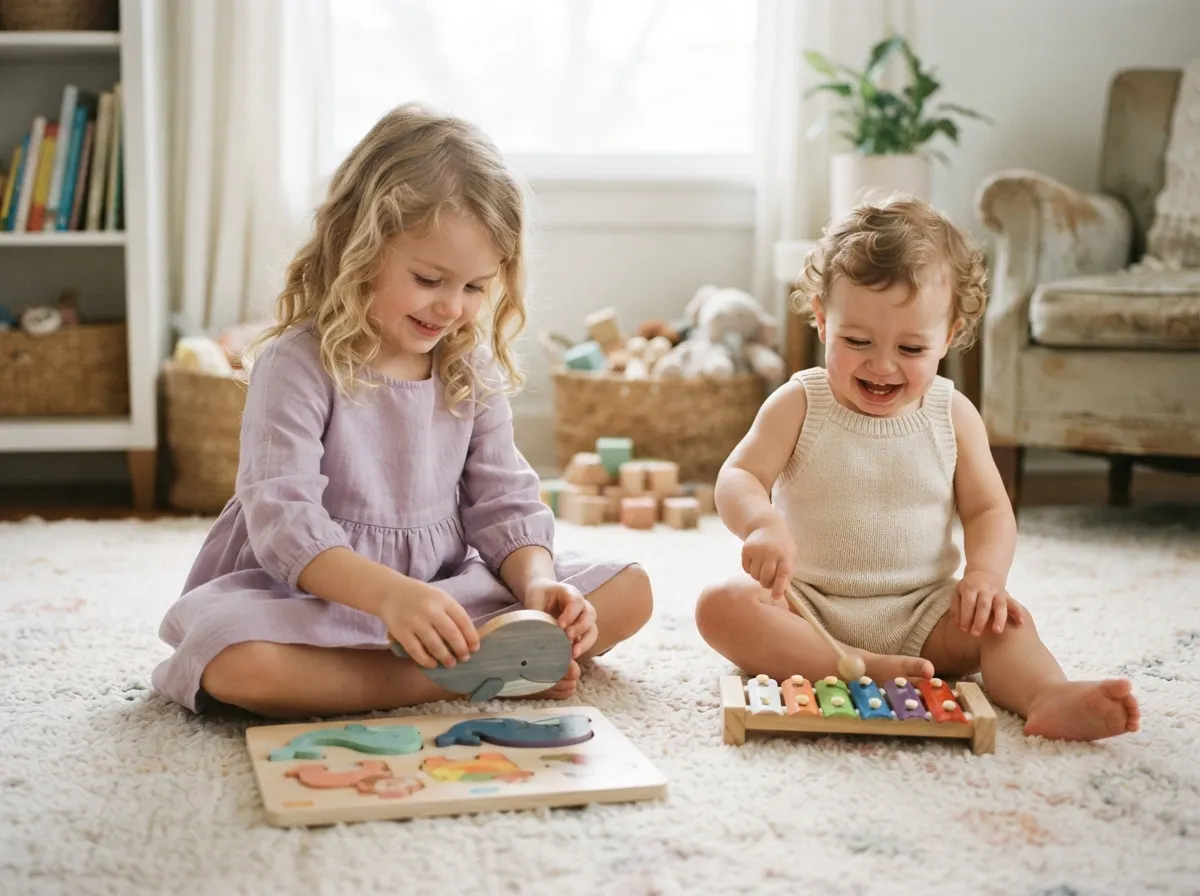
- A xylophone or simple instruments. Rhythm, colours and a lot of happy noise.
- Building blocks. Towers, bridges and roads for toy cars.
- Dolls, teddies and small figures. For role play and talking about feelings.
What to look for: open-ended toys that can be played with in many ways tend to last longer than toys that do one thing at the press of a button.
What are the best learning toys for 3 to 4 year olds?
Preschoolers are ready for early maths, longer stories and more complex building. They also love to sort and collect.
- Counting bears or counters. Counting, sorting by colour and making patterns. These are small pieces, so they suit children who no longer put things in their mouths, with an adult nearby.
- Magnetic tiles or construction sets. Shapes, symmetry and early engineering.
- Reusable sticker books. Fine motor control and storytelling.
- Simple board games. Taking turns, counting spaces and losing gracefully.
- Colouring books and paints. For pencil control that helps later with writing.
What toys are good for kids aged 5 and over?
From around 5, children ask "why" about everything. This is a great age for real experiments and building projects.
- Science kits. Crystal growing, volcanoes and simple chemistry, with adult help.
- A starter microscope. Onion skin, hair and leaves look amazing up close.
- Construction kits and circuits. Following instructions, then inventing their own.
- Outdoor explorer kits. Bug viewers, magnifiers and binoculars for the garden or park.
- Non-fiction books. Space, dinosaurs and the human body are perennial favourites.
Magnetic building tiles
Build towers, shapes and 3D models. Great for engineering and geometry.
If your child loves this kind of thing, try our easy kitchen science experiments, and browse the science kits section of our shop.
Where do learning apps fit in?
For children aged 2 and over, a short, well-designed app played together can sit alongside physical toys. Guidance from the WHO and the American Academy of Pediatrics favours very little screen time for young children, and co-viewing when screens are used. Our honest guide to screen time for toddlers goes through the details.
Baby Games: Toddler Learning, for iPhone and iPad, covers the same basics as many of the toys above: animals, colours, shapes, numbers 1 to 10 and letters A to Z, with Bo the bear as a guide. A daily Play Time is 3 to 5 short games that end with a sticker, so sessions stay short. There are no ads, and the parent area sits behind a parental gate. More on the Baby Games page.
Frequently asked questions
How many toys does a toddler really need?
Fewer than you think. Many families find that keeping a small selection out and rotating the rest every week or two keeps toys interesting for longer.
Are wooden toys better than plastic ones?
Not automatically. What matters most is that the toy is safe, suits your child's age and can be played with in more than one way.
When can my child play with toys that have small parts?
Follow the age label on the toy. Many toys with small parts are labelled for ages 3 and up because of choking risk. Supervise closely if younger siblings are around.
Do I need to buy toys for every stage?
No. Many toys, like blocks, balls and stacking cups, last for years and get used differently as your child grows.
Some links on this page go to Amazon. As an Amazon Associate we earn from qualifying purchases. It never changes the price you pay.